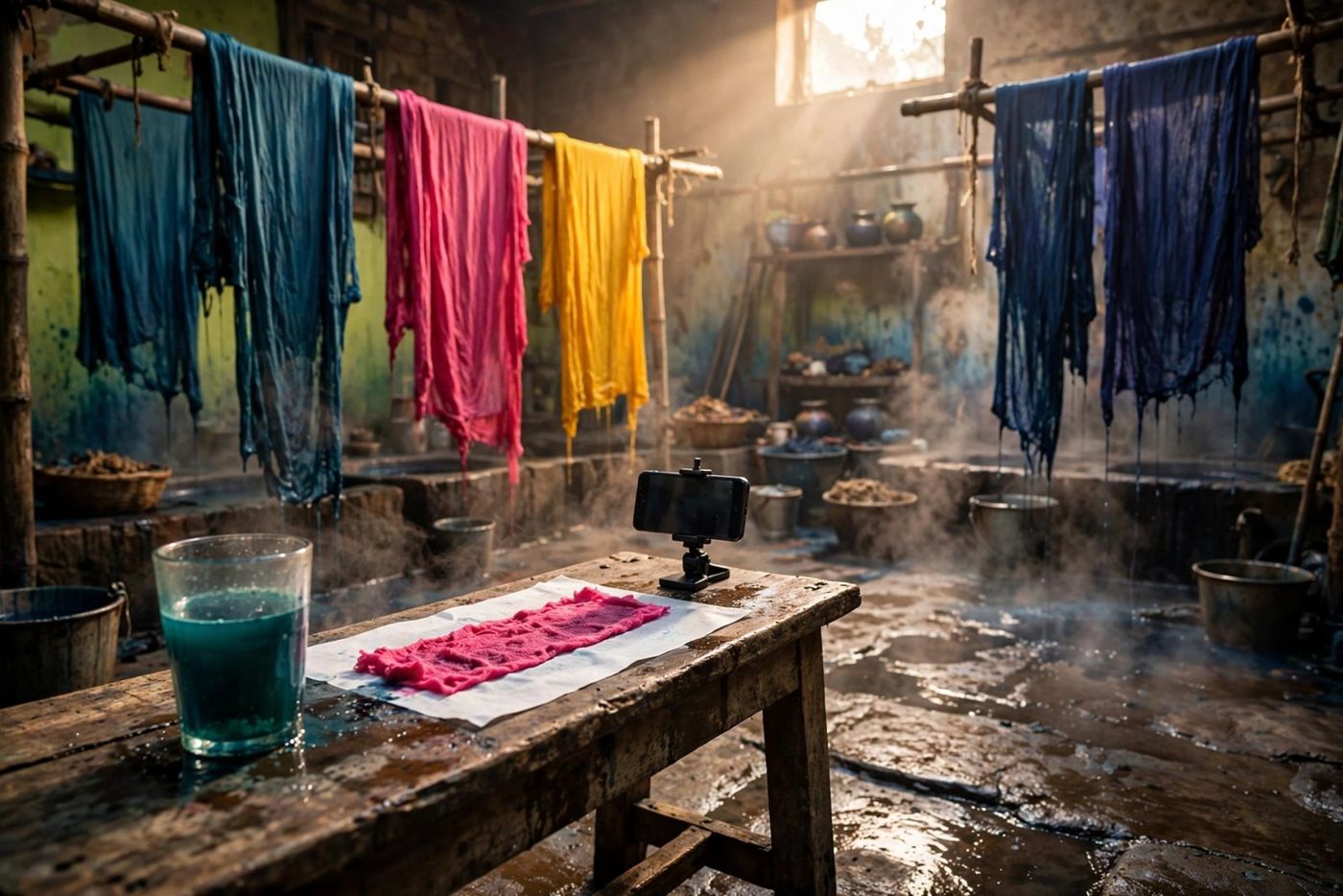
A dye house's lab dip, in minutes instead of days, from a phone.
Before a garment order is dyed, the dye house dyes a small swatch, a lab dip, and sends it to the buyer for approval. A rejected dip means correct, re-dye, re-send: usually 2 to 4 rounds of several days each. Large mills shorten this with spectrophotometers and colour-matching software. The thousands of small dye houses and job workers in India's textile towns mostly rely on a colourist's eye and repeated trials.
Rangrez runs the colourist's loop itself: pick a recipe, dye a strip, photograph it, measure it, correct it, until the cloth matches. Six Meta models each do one job in that loop.
Six Meta models, six real jobs
SAM 3.1
A measuring instrument: segments the colour card, the white paper and the dyed strip in every photo, so pixels become calibrated CIELAB.
Muse Wonder
The colourist: runs each campaign through tools (suggest, dip, refit, escalate) and writes the lab notebook. It never drives a pump directly.
Muse Glimmer 30B
Open weights, fine-tuned on the lab's own dips to propose the first recipe; v2 reads the lab's notebook. Weights published.
Muse Spark
Reads the buyer's chat message (English or Hindi) into an order, sets the pass tolerance, and drafts the reply in the buyer's language.
Muse Image
Shows the customer's garment in the approved shade; SAM measures and corrects it, because an image model is not a colour instrument.
Muse Voice Transcribe
Hands-free for a dyer with wet gloves: "done", "repeat", "stop", or "हो गया", "फिर से", "बंद करो".
What it has shown so far
All on the simulator: hidden dye chemistry and real-looking phone photos with known true colours. No real dye on real cloth yet.
0.66
median ΔE00 measuring a strip from a phone photo with the printed colour card (live SAM 3.1, 22 photos); 1.17 with white paper only
24 / 24
shades matched in a median of 2 dips on the robot rig's reactive dyes, every dip photographed in a different room
3.81 → 1.40
the first dip's error over a 40-campaign night shift, as lab memory learns the dye lot; dips per match 2.35 → 1.65
4.10 → 0.92
first-dip error, supplier's model vs fine-tuned Glimmer; a Gaussian process on the same dips reaches 0.77, and we say so
8 / 8 vs 5 / 8
live campaigns matched by Muse Wonder vs a fixed policy with the same tools and safety rules: when a correction overshot, Wonder changed method and recovered
a phone and a printed card; a $100 rig to automate
Measures the dyed cloth
by eye
precisely
no
from a phone photo, ±0.7 ΔE00 with the card
Proposes and corrects the recipe
by experience
yes
guesses
yes, from a model refitted to real dips
Runs the loop itself (recipe, dip, measure, correct)
no
no
no
yes, with a safety gate and a human escalation
Learns this dye lot across campaigns
in one head
some correction features
no
lab memory, plus a fine-tuned open model
Reads the buyer's WhatsApp order, replies in their language
no
no
if asked
Muse Spark, English or Hindi
Hands-free in Hindi
it's a person
no
no
Muse Voice Transcribe
Buyer-ready lab-dip report
no
yes
no
ΔE00 and CMC 2:1, options A/B/C, recipe in % owf, production plan
A home recipe for anyone's outfit
no
no
no
photograph it, get drops of household colour
Where it stands, honestly
Simulated, not yet dyed for real. The physics, photos and chemistry are simulated. The first real campaign, household colours on a cotton strip with a phone, is the next step.
The robot rig is designed, not built. Firmware, wiring and a virtual ESP32 that runs the real driver are done; the parts are about ₹8,000.
A camera is a pre-screen, not a certificate. ±0.7 ΔE00 with the card is good enough to correct fast, not to certify a strict 1.0 pass; it cannot check metamerism. Final approval stays with the buyer's instrument or light booth.
A lab dip must follow the bulk process. Fixing, rinsing and soaping are in the protocol; transferring a recipe to bulk still needs the dye house's own lab-to-bulk factor.
Household colours are for learning and play. Food colours and inks are not wash-fast; dye houses use reactive dyes.
Glimmer is not magic. On the same data a Gaussian process matches it; Glimmer earns its place by reading the lab's notebook and working with language.
Why it can work
Technically
Runs on a laptop and a phone; the measuring, chemistry and safety are plain tested code, and the Meta models do what they are best at. Every campaign is recorded and replayable.
For the business
Each avoided round saves days of a buyer's lead time and a courier; the report is the document the buyer already asks for. Per-dip or monthly pricing for small dye houses and sourcing agents.
For the people using it
Phone first, Hindi, hands-free, WhatsApp-shaped. No new instrument to learn: photograph, dip, send.
The adoption path
1) assisted mode with a phone, zero capex; 2) the $100 rig for unattended dips; 3) a handheld spectrophotometer in place of the camera for strict shades, same agent and memory.
What it could become
Real-dye pilots with job-work dye houses in Tiruppur and Erode.
Spectral camera calibration, and profiles for polyester (disperse dyes) and wool.
Glimmer reading the dip photo itself, not just numbers.
Lab memory shared across dye houses that use the same dye lots, without sharing their recipes.